
Outcome Documents for
200 Years of Johnson v. M’Intosh (JvM): Indigenous Responses to the Religious Foundations of Racism
This website is the official archive of the outcome publications from the Henry J. Luce Foundation Grant Funded project “200 Years of Johnson v. M’Intosh (JvM): Indigenous Responses to the Religious Foundations of Racism". Professor Philip P. Arnold was the PI on this project which ran from 2022-2024. Project activities included a conference, podcasts, and various types of publications.
Summary #
“200 Years of Johnson v. M’Intosh (JvM): Indigenous Responses to the Religious Foundations of Racism,” is a collaborative initiative made possible through relationships developed over 30 years between academic and Indigenous communities. At its core, the project seeks to interrogate and critically examine connections between the Doctrine of Christian Discovery (DOCD), the Catholic Papal Bulls that undergird the Doctrine, and the Doctrine’s pernicious influence on United States Indian Law today.
The 200th anniversary of JvM provides an excellent moment to challenge the theology and jurisprudence of DOCD and this critical Supreme Court decision. The project will deliver a range of digital products and written works combined with a host of public outreach activities to raise awareness about the harmful impacts of the DOCD and provide support for a global movement of Indigenous People’s that seek to repudiate it.
Federal Anti-indian Law: Why a Challenge to “Christian Discovery” Creates a Metaphysical Crisis for the US
Peter d'Errico argues that U.S. anti-Indian law rests on Christian Discovery, and that challenging it exposes a metaphysical crisis in U.S. law today.
 Peter d'Errico
Right & Respectful Relations: A Memoir of the Road to the Historic Yakama Nation Amicus Brief Challenging ‘Christian Discovery’ in Washington State V. Cougar Den
Jode Goudy recounts how the Yakama Nation built a historic amicus brief, connecting treaty rights, sovereignty, and opposition to Christian Discovery.
Jode Goudy
The Doctrine of Christian Discovery and Domination: How It Has Been Used by United States Courts to Deny Treaty Rights & Dismiss the Haudenosaunee Land Rights Cases
Joseph J. Heath shows how U.S. courts use Christian Discovery to deny Haudenosaunee treaty and land rights, and calls for its repudiation in U.S. law.
Joseph J. Heath
The International Law of Colonialism: The Doctrine of Discovery
Robert J. Miller traces how the Doctrine of Discovery became international law, enabling colonial claims over Indigenous land, rights and sovereignty.
Robert J. Miller
My Decades-long Inquiry Into the Doctrine of Christian Discovery and Domination
Steven Newcomb reflects on decades studying Christian Discovery, showing how law and language normalized domination over Native nations for centuries.
Steven T. Newcomb
An Intergenerational and Perpetual Imperium of Domination and Subjugation of Indigenous Peoples: The Doctrine of Christian Discovery and Royal Supremacy
Phillip Rodgers-Falk argues that native title and colonial sovereignty preserve Indigenous subordination through terra nullius and racial hierarchies.
Phillip Rodgers-Falk
An Appeal to the American People—Overturning “Federal Indian Law”
Steven J. Schwartzberg urges Americans to overturn Federal Indian Law by confronting the colonial assumptions that still shape U.S. jurisprudence now.
Steven J. Schwartzberg
Conclusion: Dismantling the Doctrine of Christian Discovery Cultivating Right Relations
The conclusion calls for decolonization beyond legal reform, centering Indigenous law, land return, and right relations to resist Christian Discovery.
Philip P. Arnold
Sandra Bigtree
Adam DJ Brett
A Postscript: Sovereignty is Still the Issue
This postscript argues Indigenous nations need full sovereignty, rejecting settler carve-outs and urging a healing return to precolonial lifeways now.
Adam DJ Brett
Betty Hill (Lyons)
Nethanial Belmont
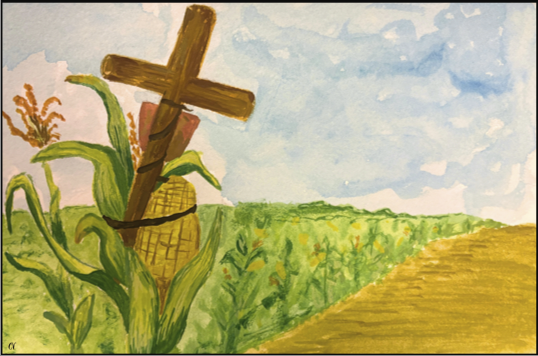
A Preface to Challenging the Justifications of Domination Through Religion: “We Were Planting Corn, and They Were Planting Crosses”
Preface to a special issue examining Christian Discovery’s role in white supremacy, law, and education, with decolonial paths grounded in Indigenous justice.
Philip P. Arnold
Sandra Bigtree
Adam DJ Brett