
Outcome Documents for
200 Years of Johnson v. M’Intosh (JvM): Indigenous Responses to the Religious Foundations of Racism
This website is the official archive of the outcome publications from the Henry J. Luce Foundation Grant Funded project “200 Years of Johnson v. M’Intosh (JvM): Indigenous Responses to the Religious Foundations of Racism". Professor Philip P. Arnold was the PI on this project which ran from 2022-2024. Project activities included a conference, podcasts, and various types of publications.
Summary #
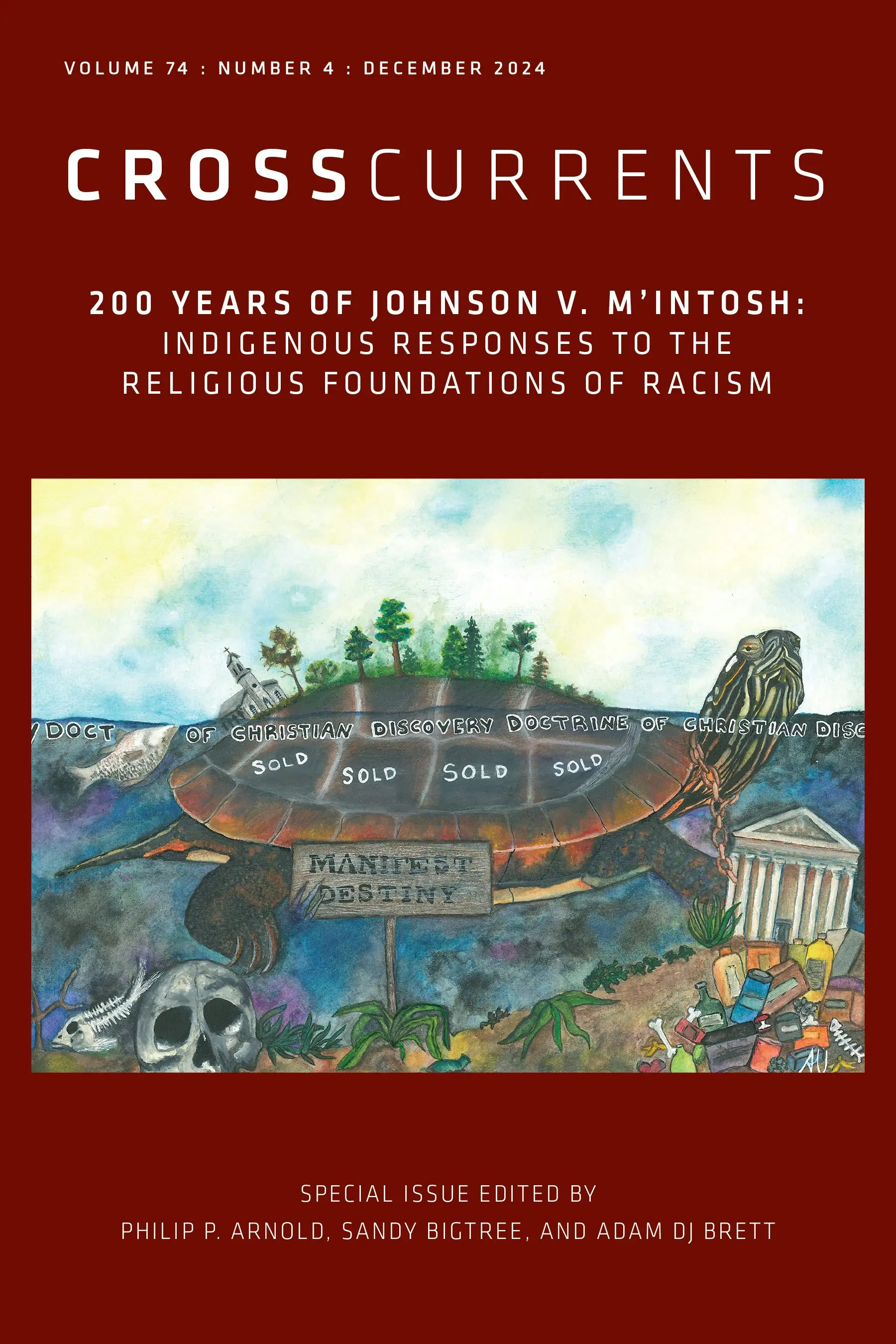
“200 Years of Johnson v. M’Intosh (JvM): Indigenous Responses to the Religious Foundations of Racism,” is a collaborative initiative made possible through relationships developed over 30 years between academic and Indigenous communities. At its core, the project seeks to interrogate and critically examine connections between the Doctrine of Christian Discovery (DOCD), the Catholic Papal Bulls that undergird the Doctrine, and the Doctrine’s pernicious influence on United States Indian Law today.
The 200th anniversary of JvM provides an excellent moment to challenge the theology and jurisprudence of DOCD and this critical Supreme Court decision. The project will deliver a range of digital products and written works combined with a host of public outreach activities to raise awareness about the harmful impacts of the DOCD and provide support for a global movement of Indigenous People’s that seek to repudiate it.
The Roots of Christian Nationalism Go Back Further Than You Think
The term "white Christian nationalism" has emerged in recent years to describe a worldview that has become central to the contemporary Republican Party. This ideology has deep roots in the Doctrine of Discovery, a series of papal bulls from the fifteenth century that claimed European civilization and Christianity were superior to all other cultures. This doctrine provided the moral and religious justification for European colonial conquest and the African slave trade. The contemporary white Christian nationalist movement is a continuation of this cultural stream that has run through America since the arrival of Europeans five centuries ago. To move forward, white Christians must confront their role in benefiting from this legacy of oppression and work towards repairing the damage done.
 Robert P. Jones
DEAR AUTOCRAT(S)
A poem is presented - We never strived to be your equals Or fought for that sameness of identity There was no reason for uprising Against your anthropocentric prototyped pattern Foreseen long before your arrival Because we had established equivalent equity Millennium prior to your pilgrimage of biblical conquest And your utopian misunderstanding of our communities And your fear of the unknown
 Sawatis Frushell
Travelling Along the River of Life
Lyons discusses the journey in the Doctrine of Discovery, highlighting his experience presenting at the United Nations in 2001. He focuses on the history of the Haudenosaunee Confederacy, emphasizing the importance of peace and the responsibility to consider future generations. He also reflects on the impact of inequity, racism, and the need for change.
 Oren Lyons
Toward a Kinder Future
The Church needs to make commitments to undo the damage of instilling white superiority beliefs. Churches worldwide can be part of a campaign to change the effects of domination and undo the belief in white superiority. Healing is needed between Indigenous people and those seeking reconciliation after a difficult history. Efforts are being made to address the effects of the boarding school era on Native families. Apologies have been made, but change is necessary. Steps towards healing and recovery include admitting harmful beliefs, sharing with others, releasing emotions, and resolving not to harm others in the future. Being an ally and speaking up against hatred and threats to Native people is important.
 Whatweni:neh Freida J. Jacques
Comments on the Bishop's Panel: Transcription of Conference Presentation
Greetings to you all. I'm Haiwhagai'i, Onondaga Nation, Eel Clan. I have to start off with gratitude for seeing all of your faces here. It is a bit awkward for me to be sitting here on a panel with 3 bishops. It's true there is plenty of sin like was mentioned and more of it has come to the surface. We hear about the promises today and we heard about the confessions. We have to stick with the truth, and the truth of the matter is there is no trust.
 Jake Haiwhagai'i Edwards
The Challenges of Revoking the Papal Bulls: A View-from-the-Shore Analysis of Recent Statements by Christian Churches
Let us set the context for this discussion. The context begins with the free existence of our Native nations and peoples, extending back to the beginning of our time through our oral histories and traditions, contrasted with the system of domination that was carried by ship across the ocean and imposed on everyone and everything. From that starting point we end up with a non-Christian view-from-the-shore with our Ancestors looking out at the invading ships sailing from Western Christendom, and a view-from-the-ship perspective, with the colonizers moving toward our Ancestors with the intention of establishing the Christian empire's system of domination where it did not yet exist
 Steven T. Newcomb
The Construction of Indigenous Americans and Spanish Conquistadors in Theodore de Bry's Engravings
The primary visual sources depicting the treatment of Indigenous peoples by conquerors, particularly the works of Protestant engraver Theodore de Bry, offer valuable insights into the interactions between European explorers and Indigenous Americans. De Bry's illustrations, influenced by Bartolomé de Las Casas's accounts of Spanish atrocities, serve as a condemnation of Spanish Catholic colonization in the Americas. Through his engravings, de Bry politicizes and weaponizes Indigenous bodies, portraying them as deserving of conquest and civilizing, albeit by Protestant conquerors. His depictions of Indigenous peoples, based on biased accounts relayed from explorers, perpetuate stereotypes used to justify colonization. De Bry's Protestant vision, evident in his works, advocates for Protestant colonization as a preferable alternative to Spanish Catholic conquest. Despite condemning Spanish abuses, de Bry's ultimate goal is not to end colonialism but to promote Protestant colonization in the Americas.
Isabel V. Maine-Torres
An Unholy Wedding: Christianity, Civilizational Supremacy, and the In/visibility of "Race" in Post-colonial Philippines
An often-heard truism among homeland Filipinos in conversations with their diasporic counterparts in the United States is the notion that race and racism are irrelevant categories when it comes to the Philippines. 'Don't export your racism to us,' is the usual protest. 'There's no racism in the Philippines.We all descend from the islands' original peoples.' Wary—and rightfully so—of the often-decontextualized exportation of debates and discourses to the home country (as has been the case historically in a kind of center-periphery trajectory), one interlocutor quips: 'You cannot employ the white settler colonizer vs. Indigenous in North America to the paradigm of the Philippines. … People from the Philippines, yes, including many from different Indigenous groups … do not consider themselves so removed from [other] Filipinos who are not part of their heritage.'
 S. Lily Mendoza
Christian Nationalism in the Lithuanian Context
The transition of Lithuania from a pagan to a Roman Catholic culture began with Pope Innocent IV's issuance of Bulls in 1251. Mindaugas, Grand Duke of Lithuania, was baptized Christian, and Lithuania was placed under the jurisdiction of the Bishop of Rome. The Dominicans led crusades against pagans in Prussia and Livonia. Later papal Bulls by Pope Alexander IV further solidified Roman Catholic dominance in Lithuania. The Roman Catholic Church has played a significant role in Lithuania's history and continues to influence its national identity. Christian Nationalism, intertwined with Roman Catholicism, shapes Lithuania's social and political order. Religious NGOs and the Lithuanian Parliament play a role in preserving traditional values and opposing perceived threats. The conflict between Roman Catholicism and traditional Baltic religion, exemplified by the Romuva community, reflects tensions in defining Lithuanian national identity.
 Eglutė Trinkauskaitė
Routing Out Supremacy's Religious Roots: From Skin Color Back Through Bible Code to City-State Coercion
Perkinson discusses the origins of colonialism and white supremacy, tracing it back to the relationship with the land. He explores the shift from pastoral-nomad lifeways to city-state agriculture, leading to a myth of cultivar sovereignty and Christian supremacy. He argues that white supremacy is rooted in a myth of mastery over the non-human world, with a focus on urban-centered control of land. He highlights the resistance of pastoral nomad traditions against city-state coercion and the importance of a respectful land-based symbiosis. Furthermore, he stresses that the deep historical taproot of white supremacy implies a particular relationship to land centered in cities, supported by farmlands, and ultimately leading to the enslavement of both land and non-humankind.
 James W. Perkinson